The sentence turns up in some form nearly every time I talk to a woman building something in her next phase of life.
“I feel like everyone else figured out something I missed.“
She’s followed the advice. Read the books, taken the course, done the thing the podcast told her to do. Some of it twice. And the results still don’t match the effort, which is the part that starts to feel personal, because at some point the gap stops looking like a strategy problem and starts looking like evidence about her.
What I think is actually going on is duller than that, and a great deal more fixable.
The advice wasn’t wrong. It just wasn’t written for where she was standing.
Let me show you with my own
I put four stages inside the Quiet Business Compass™, and each one comes with a short list of what actually moves you from there. Two of those lists contradict each other, on purpose.
Here’s one, for the woman who has built the thing, followed the advice, and is hearing crickets:
Stop consuming for one week. No new courses, no new strategies, no research into what you might be missing.
I stand behind that.
For her it’s the single most useful week she could spend, because the answer she’s looking for is already in her business and she keeps burying it under new input.
Now give that same instruction to a woman whose idea still lives mostly in her head.
It does nothing.
There’s nothing to stop consuming for. She’d just be sitting quietly with an idea, which is what she was doing before she read it, except now she feels vaguely guilty about the podcast.
Here’s one from the other end, for the woman whose business is genuinely working:
Before you add anything new, ask what you’d have to stop doing to make room for it.
Also mine. Also right. At that stage, adding is the thing most likely to break what’s finally holding together.
Give it to a beginner and you’ve handed her a reason to stall. She has nothing to protect yet. Asking what she’d give up to make room is like asking what furniture she’d move out of a house she hasn’t built.
Same advice. Same woman, even. Two completely different answers, and the only variable that changed is where she was standing when she read it.
The part that took me longer to see
The stages aren’t a ladder.
Most frameworks in this industry sort people by revenue, or by how many years they’ve been going. That’s tidy, and it’s close to useless, because it measures what somebody has accumulated rather than what she’s currently up against.
The woman who’s done with the playbook, who’s been burned by enough systems that she now trusts her gut over the next expert, might be earning more than the woman who’s found her groove. Being behind has nothing to do with it. She’s working a different problem, and the fix for hers would be noise to the other one.
I know this because I went backwards on purpose.
For the better part of a decade I ran Geek in Your Pocket. It worked. Real clients, real rhythm, real evidence. By any sensible measure I was at the far end of the thing, the stage everybody says they’re aiming for. Then I closed it and started again with an idea that lived mostly in my head and one sentence I couldn’t say cleanly out loud.
Back to the beginning, by choice, at an age when the advice suggests you should be consolidating.
And every piece of good advice for where I’d just been became the wrong advice overnight. Protect the shape. Don’t add. Ask what you’d stop doing. All of it correct where I’d come from. All of it useless where I was standing, which was in front of a blank page with thirty years of experience and no sentence.
So what do you do with this
You stop taking the advice personally, first of all. Good advice at the wrong moment mostly fails, and the failure says nothing about you except that you were reading generously.
Then you work out where you’re standing, which sounds obvious and almost nobody does it deliberately. We tend to know our revenue, our list size, our follower count, and to have no working answer at all to the plainer question: what am I actually up against right now?
That question has an answer. It’s usually one of four, and the numbers on their own will point you at the wrong one.
And once you have it, the advice sorts itself. Half of what you’ve been carrying around turns out to belong to a woman two stages away from you, and you can put it down. The rest gets sharper, because now you know why it’s for you.
Everyone says something different because everyone is writing to a different woman. Find out which one you are and most of the noise stops being noise. It just becomes somebody else’s mail.
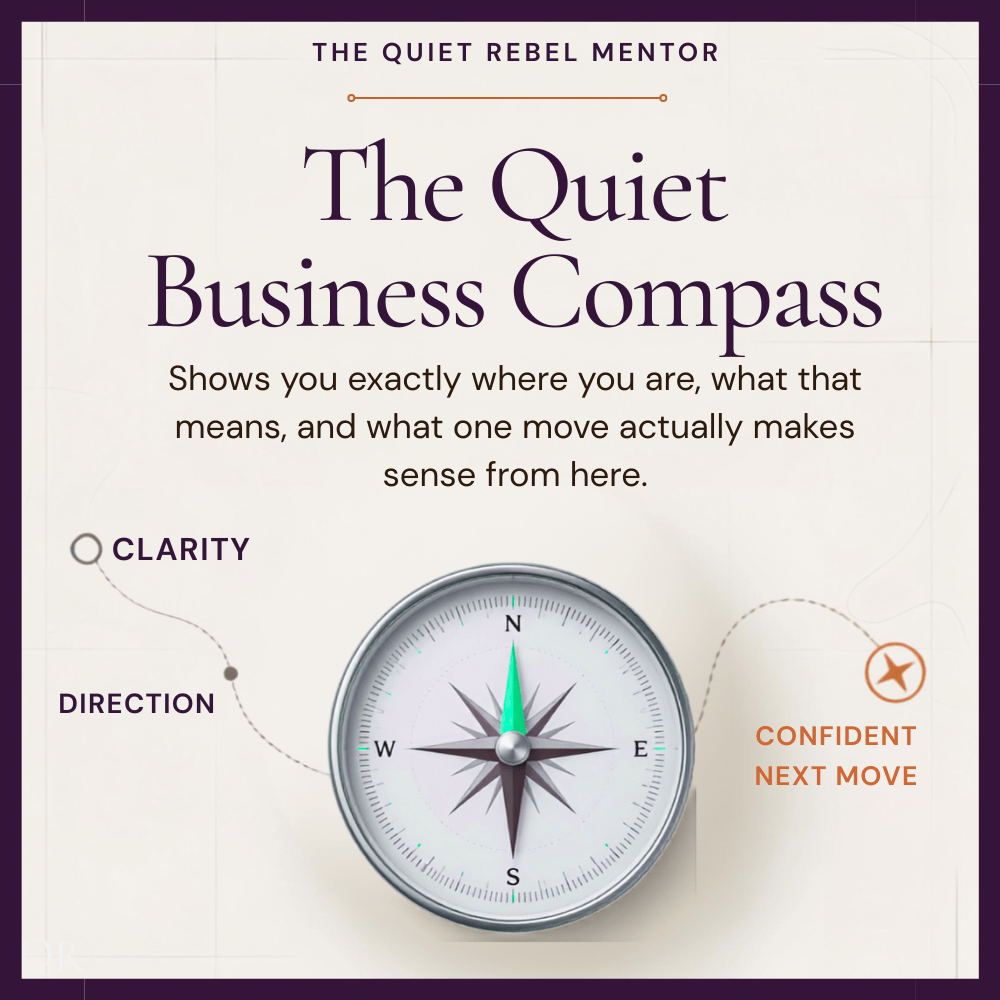
Two minutes, four stages. The Quiet Business Compass asks you a short set of questions and tells you which stage you’re actually in, what that stage means, and the one move that makes sense from there. It’s free.
If you come out of it wanting the longer version, The Quiet Business Roadmap is a five-step guide built on the ENOUGH Method™, about ten minutes a step, and you finish with one page: what you’re building, what matters now, what can wait, and your next real step. $47.
Build quietly, rebel loudly.It’s your business, your energy and your rules.