A Small, Warm List Beats a Big, Cold One
The day I stopped caring about the size of the list was the day the business started to make sense.
Read This Essay →
Business Strategy
9 min read
There was a moment, somewhere in year three of running this business, when I realized I had been performing.
Not lying, exactly. The work was real, the clients were real, the hours were very real. But I’d been showing up to my business the way you show up to a dinner party at someone else’s house. Slightly dressed up. A little careful about what you say. Aware of the impression you’re making, even if you can’t quite name whose impression you’re worried about.
That last part is the part worth sitting with. I couldn’t tell you whose expectations I was performing for. There was no specific audience, no one person I was trying to impress. It was more like I’d absorbed a picture of what a real business owner looked like and I was trying to fit myself into it, without ever asking whether the picture fit me.
I did the things you’re supposed to do. I picked a niche, or tried to. I showed up on platforms I didn’t particularly enjoy because someone said I should. I created offers based on what I thought the market wanted rather than what I was actually best at. I avoided the topics I was most drawn to because they felt too personal, too small, too “not business enough” to take seriously.
What I was building, I eventually understood, was a business for an imaginary person. And the background friction that came with that never went away. It just got quieter as I got busier.
Burnout gets a lot of airtime. And burnout is real. But what I’m describing here isn’t burnout. Burnout is exhaustion. This is something more specific, and for a lot of people more persistent.
It’s the feeling of working hard and still feeling slightly off-key. Like the effort is there but the resonance isn’t. You’re moving, you’re producing, you’re crossing things off the list. But something doesn’t fit, and you can’t quite name it, and the closest you get to naming it is just this recurring sense that you’re doing all the right things and somehow still building the wrong thing.
Most solopreneurs I talk to know this feeling. They’ve known it for years. They’ve just never had a name for it or a way to look at it directly.
I’ve started calling it identity friction. And unlike burnout, you can’t fix it by resting. You have to look at it.
The friction isn’t about effort. It’s never about effort.
It’s about the gap between who you actually are and who you’ve been performing in your business. That gap has weight. It doesn’t disappear because you push through it. It compounds.
Here’s the honest version of how this happens, at least how it happened for me.
We start a business, most of us, with some combination of what we’re good at and what we think will sell. We look at what other people are doing. We listen to advice from people who’ve built businesses, people who teach business, courses and coaches and content about how to do the thing correctly. We absorb it, often without realizing we’re absorbing it, and we start to shape our work around the models we’ve taken in.
And the models are usually built for someone else.
Not maliciously. Most of the advice out there isn’t wrong, exactly. It’s just not specific to you. It’s built on patterns that work for a certain kind of person with a certain kind of business, and if that person isn’t you, the advice still sounds reasonable and you’ll follow it, and it will produce a business that functions but doesn’t fit.
The other thing that happens, and this one is quieter, is that we start to edit ourselves before anyone has even asked us to. We take the topic we’re most interesting on and decide it’s too personal for a business context. We take the way we naturally work and decide it’s too idiosyncratic to explain. We take the offer we’d actually love to make and talk ourselves out of it before it’s even written down.
Column two of the audit is full of things we talked ourselves out of before anyone else had the chance to.
When I started talking about this in my work, the first question was almost always: “So you’re saying I need to rebrand?”
I’m not.
Rebranding is a presentation decision. This isn’t a presentation problem. You can change the colors on something built on a shaky foundation, and it will still shake. What I’m describing is a foundation question. Who’s actually building this thing, and is the thing they’re building actually theirs?
The Business Identity Audit is three columns on a piece of paper. No app, no framework, no five-week deep dive. Three columns that force you to look at the gap between what you’re doing and what you’d actually build if you weren’t trying to impress anyone.
Column One: What am I doing right now in my business? Not what I’m planning or considering. What is actually happening. The offers I’m selling, the content I’m making, the work I’m taking on. Write it down without commentary, just inventory.
Column Two: What am I actively avoiding? This one takes more honesty. What topics do I sidestep in my content? What offers have I thought about but talked myself out of? What kind of work do I quietly wish I could stop doing? What comes naturally to me that I dismiss as not serious enough, not scalable enough, not the thing I’m supposed to be known for?
Column Three: What would I build if there was no one to impress and no standard to meet? If there was no right answer about what a business should look like. No platform telling you what works. No sense that you’re supposed to be more visible, more scalable, more anything. What would you actually build?
Write it down honestly. All three columns.
Then look at the gap between column one and column three.
That gap is where the audit lives.
For some people, it’s small. They’ve been doing this long enough or they’ve just gotten lucky with a fit between who they are and what they’ve built. The gap between what they’re doing and what they’d do if no one was watching is narrow and the friction is low.
For a lot of people, it’s not small.
There are years of “this is how you build a business” layered over “this is actually what I want to be doing.” There are whole categories of work sitting in column two that got there because someone once said you couldn’t make money with that, or you watched someone else do it badly and assumed it wouldn’t work, or you convinced yourself that the thing you do most naturally can’t possibly be the thing people pay for.
Not everything in column two belongs on your list. Some avoidances are just good judgment. But some of them have been there for years, quiet and persistent, because of someone else’s standard, or an old piece of advice that stuck, or a version of yourself you’d been performing that didn’t have room for them.
Those are the ones worth examining.
The question isn’t “why am I avoiding this?” The question is “whose idea was it that I should?”
I want to be specific about this because the word “shift” can sound larger than it is.
Doing this exercise didn’t produce a dramatic pivot for me. I didn’t burn down what I’d built or start over in a new niche or make some public declaration about who I really was. What it produced was one decision.
I stopped avoiding a certain kind of conversation I’d been having with clients for years because it felt too personal for a business context. I just started having it in public instead of only in private.
That’s it. One thing moved out of column two and into column one.
But that one thing changed what I was building in a way that three years of strategy work hadn’t. Because it was mine. It fit. The friction I’d been carrying for years got lighter almost immediately, not because the work got easier but because it finally resonated.
The shift, when it comes, is usually that quiet. One thing you’ve been avoiding that finally gets permission. One thing you’ve been doing out of obligation that finally gets questioned.
You don’t have to blow everything up. You just have to close the gap.
The Quiet Edge Framework™ moves through six pillars. Identity is first, and it’s first because everything else depends on it.
You can’t build a narrative that lands until you know who’s doing the talking. You can’t design systems that support you until you know what you’re trying to sustain. You can’t make an offer that fits until you understand what “fit” actually means for you specifically, in this business, at this stage.
All of that starts here.
Not because the three-column exercise is magic. It’s not. It’s just paper and honesty. But most of us have spent years looking slightly away from the gap between what we’re doing and what we’d actually build if no one was watching. The audit just makes you look at it directly.
That’s enough to start.
If you want to keep going, here is the next question to ask: once you can see the gap, what should you actually do about it first? That answer changes depending on where you are in your business.
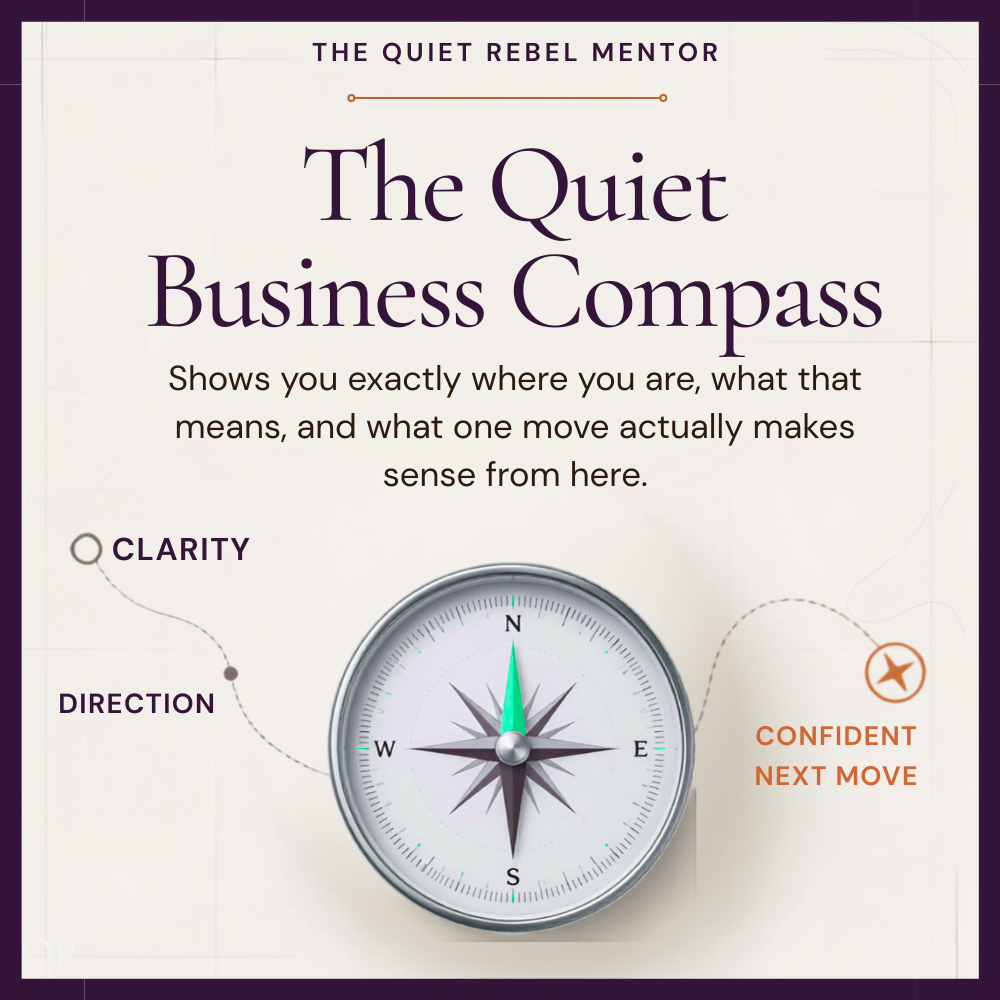
The Quiet Business Compass is a short set of questions that tells you which stage you are actually in, and what matters most there.
The next essay in this series goes into what happens after you know who you are. Because knowing it and being able to say it are two entirely different problems.
Keep reading